


| INDY 500 TRADITIONS |


Indianapolis 500
History & Traditions
History & Traditions
| Related Links: |
Copyright © 2001 IndySpeedway.com All Rights Reserved
The garage area is still called Gasoline Alley, even though drivers haven't used gas in
more than 30 years.
The final practice is still known as Carburation Day, although fuel injection systems
replaced carburators decades ago.
The winners have swigged a bottle of milk in Victory Lane every year since 1933,
except when orange-grove owner Emerson Fittipaldi drank orange juice nine years ago.
It's just tradition, you see.
While there have been big changes at the Indianapolis 500 recently, tradition is still
embraced.
"The biggest tradition is it's the Indianapolis Motor Speedway. It's like the Kentucky
Derby," said A.J. Foyt, the first four-time winner of the race.
"Everybody knows where the Indianapolis 500 is, that it's the biggest spectator sport
in the world, the biggest race," he said.
The speedway, originally a testing ground for the auto industry in the early 1900s,
claims a tradition from the very first 500-mile race in 1911 -- the use of a pace car.
"They thought there were too many cars for a standing start and that it would be safer
to lead them around with a passenger car and release them with a flag," speedway
historian Donald Davidson said. "We believe that's the first mass rolling start for a
race anywhere and, therefore, quite possibly the first use of a pace car to start a
race."
Which brings up the tradition of 33 cars lined up three abreast. Where did they come
up with that number and configuration, anyway?
The first two races, in 1911 and 1912, had 40 and 24 entries, respectively, but they
were lined up in rows of five. From 1913 to 1920, the cars were lined up four abreast,
then for safety reasons, the traditional three-abreast lineup began in 1921.
The number of cars fluctuated from a low of 21 in 1916, the year before the track was
closed for World War I, to a high of 42 in 1933. With a few exceptions, it has remained
33 since then, based on an American Automobile Association recommendation of at
least 400 feet of track per car on the 21/2-mile oval.
The 1933 race also established the milk tradition.
It was a very hot day, and after the race, winner Louie Meyer made a beeline for his
garage, where he had a bottle of buttermilk in an icebox. As he drank, a photographer
just happened to pass by, and the next morning, Meyer's picture -- bottle to lips -- was
in the newspaper.
Indiana dairy people thought it was great publicity and talked the speedway into letting
them have a bottle waiting for the winner. It's been there ever since.
As for Victory Lane, the tradition for the post-race celebration in a special enclosed
area goes back to at least 1920. Victory Lane remained on the same spot at the south
end of the pits until 1970, when it was moved to its present location in front of the
Tower Terrace at the start-finish line.
Another tradition dating from the 1920s is Carburetion Day, originally used as one final
tuneup when teams could adjust the carburetors.
By the early '50s, carburetors were on the way out, but by then, the tradition had been
firmly established. No one has ever suggested changing it.
"The last time they had carburetors was 1963, and they were pretty few and far
between then," Davidson said.
The next year, they were gone forever.
Also in 1964, a horrendous crash and fire that killed drivers Eddie Sachs and Dave
MacDonald marked the last time cars used gasoline.
Starting in 1965, they were fueled with the safer, less volatile methanol. Gasoline
Alley, however, remains.
The tradition of the pre-race singing of "Back Home Again in Indiana" goes back to
1946, the first race after the track was closed four years for World War II and the first
under the ownership of Tony Hulman. The Hulman era also ushered in the tradition of
one of the most famous commands in sports, "Gentlemen, start your engines."
Mary Fendrich Hulman isn't around to give the command. She died in 1998 at age 93.
Mrs. Hulman had told drivers to start the race almost every year since 1977, when her
husband, Tony, died.
In her place, her daughter, Mari Hulman George, carries on the tradition at an event
still billed as "The Greatest Spectacle in Racing."
more than 30 years.
The final practice is still known as Carburation Day, although fuel injection systems
replaced carburators decades ago.
The winners have swigged a bottle of milk in Victory Lane every year since 1933,
except when orange-grove owner Emerson Fittipaldi drank orange juice nine years ago.
It's just tradition, you see.
While there have been big changes at the Indianapolis 500 recently, tradition is still
embraced.
"The biggest tradition is it's the Indianapolis Motor Speedway. It's like the Kentucky
Derby," said A.J. Foyt, the first four-time winner of the race.
"Everybody knows where the Indianapolis 500 is, that it's the biggest spectator sport
in the world, the biggest race," he said.
The speedway, originally a testing ground for the auto industry in the early 1900s,
claims a tradition from the very first 500-mile race in 1911 -- the use of a pace car.
"They thought there were too many cars for a standing start and that it would be safer
to lead them around with a passenger car and release them with a flag," speedway
historian Donald Davidson said. "We believe that's the first mass rolling start for a
race anywhere and, therefore, quite possibly the first use of a pace car to start a
race."
Which brings up the tradition of 33 cars lined up three abreast. Where did they come
up with that number and configuration, anyway?
The first two races, in 1911 and 1912, had 40 and 24 entries, respectively, but they
were lined up in rows of five. From 1913 to 1920, the cars were lined up four abreast,
then for safety reasons, the traditional three-abreast lineup began in 1921.
The number of cars fluctuated from a low of 21 in 1916, the year before the track was
closed for World War I, to a high of 42 in 1933. With a few exceptions, it has remained
33 since then, based on an American Automobile Association recommendation of at
least 400 feet of track per car on the 21/2-mile oval.
The 1933 race also established the milk tradition.
It was a very hot day, and after the race, winner Louie Meyer made a beeline for his
garage, where he had a bottle of buttermilk in an icebox. As he drank, a photographer
just happened to pass by, and the next morning, Meyer's picture -- bottle to lips -- was
in the newspaper.
Indiana dairy people thought it was great publicity and talked the speedway into letting
them have a bottle waiting for the winner. It's been there ever since.
As for Victory Lane, the tradition for the post-race celebration in a special enclosed
area goes back to at least 1920. Victory Lane remained on the same spot at the south
end of the pits until 1970, when it was moved to its present location in front of the
Tower Terrace at the start-finish line.
Another tradition dating from the 1920s is Carburetion Day, originally used as one final
tuneup when teams could adjust the carburetors.
By the early '50s, carburetors were on the way out, but by then, the tradition had been
firmly established. No one has ever suggested changing it.
"The last time they had carburetors was 1963, and they were pretty few and far
between then," Davidson said.
The next year, they were gone forever.
Also in 1964, a horrendous crash and fire that killed drivers Eddie Sachs and Dave
MacDonald marked the last time cars used gasoline.
Starting in 1965, they were fueled with the safer, less volatile methanol. Gasoline
Alley, however, remains.
The tradition of the pre-race singing of "Back Home Again in Indiana" goes back to
1946, the first race after the track was closed four years for World War II and the first
under the ownership of Tony Hulman. The Hulman era also ushered in the tradition of
one of the most famous commands in sports, "Gentlemen, start your engines."
Mary Fendrich Hulman isn't around to give the command. She died in 1998 at age 93.
Mrs. Hulman had told drivers to start the race almost every year since 1977, when her
husband, Tony, died.
In her place, her daughter, Mari Hulman George, carries on the tradition at an event
still billed as "The Greatest Spectacle in Racing."
Agajanian family an Indy tradition
By SHAV GLICK
Los Angeles Times News Service
INDIANAPOLIS (LA Times News Service 05-22-1998 18:35 EDT) -- The Agajanian
family has been coming to Indianapolis Motor Speedway for 50 years, most of the
time with a car to race. Twice they had the winning car, in 1952 with Troy Ruttman
and 1963 with Parnelli Jones.
Cary Agajanian was 6 when his father, the late J.C., left home in San Pedro to bring
his first car to the Speedway.
"I can still see my dad kissing my mother and me goodbye and hopping into a panel
truck with Johnny Mantz and Clay Smith with the race car in tow," Cary said. "That's
how he got to Indy in those days."
Mantz was Aggie's first driver and Smith his first mechanic.
The cream-and-red colored No. 98 Grant Piston Ring Special, which Mantz qualified
eighth and finished 13th with in 1948, took a couple of laps earlier this week before a
cheering crowd when the Agajanian family was honored.
"My dad used to light up, it seemed, when May came around. That was the best time
of his life every year. He just had such a good time, he had so many friends back here.
"When I come back, it makes me feel good not only because of the way our family is
treated by the Hulman-George family, but to know I'm in a place my dad loved so
much. It's an emotional thing for us."
With Cary are his brothers, Chris and J.C. Jr., all of whom are involved in motor racing.
Although all of the Agajanians have been around racing all their lives, none has ever
driven a race car. There is a reason. Cary explained:
"When my dad was 17-18 years old, he bought a race car and put it in the garage. My
grandfather [James T. Agajanian] came home and said, 'What's that?'
"My dad said, 'It's a race car. I'm going to be a race driver.'
"My grandfather said, 'OK, you have three things you have to do then.'
" 'What's that?'
" 'Well, you go inside, pack all your bags, kiss your mom goodbye, change your name,
and you can go do anything you want. That's the only three things you have to do.' "
That story was told, and retold, so many times by J.C. that by the time Cary, J.C. Jr.
and Chris might have yearned to drive, they knew their fate.
"My dad didn't have to be as forceful as his dad was, because we all knew he would
kick us out of the house and make us change our name. He didn't have to tell us, we
just knew it."
By SHAV GLICK
Los Angeles Times News Service
INDIANAPOLIS (LA Times News Service 05-22-1998 18:35 EDT) -- The Agajanian
family has been coming to Indianapolis Motor Speedway for 50 years, most of the
time with a car to race. Twice they had the winning car, in 1952 with Troy Ruttman
and 1963 with Parnelli Jones.
Cary Agajanian was 6 when his father, the late J.C., left home in San Pedro to bring
his first car to the Speedway.
"I can still see my dad kissing my mother and me goodbye and hopping into a panel
truck with Johnny Mantz and Clay Smith with the race car in tow," Cary said. "That's
how he got to Indy in those days."
Mantz was Aggie's first driver and Smith his first mechanic.
The cream-and-red colored No. 98 Grant Piston Ring Special, which Mantz qualified
eighth and finished 13th with in 1948, took a couple of laps earlier this week before a
cheering crowd when the Agajanian family was honored.
"My dad used to light up, it seemed, when May came around. That was the best time
of his life every year. He just had such a good time, he had so many friends back here.
"When I come back, it makes me feel good not only because of the way our family is
treated by the Hulman-George family, but to know I'm in a place my dad loved so
much. It's an emotional thing for us."
With Cary are his brothers, Chris and J.C. Jr., all of whom are involved in motor racing.
Although all of the Agajanians have been around racing all their lives, none has ever
driven a race car. There is a reason. Cary explained:
"When my dad was 17-18 years old, he bought a race car and put it in the garage. My
grandfather [James T. Agajanian] came home and said, 'What's that?'
"My dad said, 'It's a race car. I'm going to be a race driver.'
"My grandfather said, 'OK, you have three things you have to do then.'
" 'What's that?'
" 'Well, you go inside, pack all your bags, kiss your mom goodbye, change your name,
and you can go do anything you want. That's the only three things you have to do.' "
That story was told, and retold, so many times by J.C. that by the time Cary, J.C. Jr.
and Chris might have yearned to drive, they knew their fate.
"My dad didn't have to be as forceful as his dad was, because we all knew he would
kick us out of the house and make us change our name. He didn't have to tell us, we
just knew it."
The Voice of The 500...
By MIKE HARRIS
AP Motorsports Writer
INDIANAPOLIS (The Associated Press 05-20-1998 9:50 EDT) -- Each May for more
than a half century, Tom Carnegie's deep voice has echoed in every corner of the
Indianapolis Motor Speedway.
His bellowing cry of "Heeezonit!" for the start of a qualifying run has become as
synonymous with Indy as the phrase, "Gentlemen, start your engines."
Some people think Carnegie was here to interview Ray Harroun when he won the
first Indianapolis 500 in 1911. But the son of a Baptist minister is only 78 -- and still
going strong.
"I'm a bionic man. I have two (artificial) hips, two (artificial) knees and a restructured
femur bone," Carnegie said with a wide smile. "If I can just keep moving, I'm all right."
Carnegie is part of the experience for millions of people who have been at the
speedway since it reopened after World War II under the ownership of Tony Hulman
and Wilbur Shaw.
He came to Indianapolis in 1945 to work on a radio station and write a newspaper
sports column three days a week. A year later, he met Hulman and Shaw.
Carnegie's voice first filled the track for an old-time car parade, part of pre-race
activities. "My voice fit the PA system, so they asked me to come and work race
day," he said.
On the very first lap, Carnegie was suddenly given the microphone.
"Honestly, I didn't know much about it," he said. "But it's just like calling a basketball
game or a football game, just names and numbers. A here-they-come, there-they-go
kind of thing.
"I honestly felt that the first 10 years out here, I was not capable of saying much
more than the time of day because there's so much history here that you just have to
absorb. You can't have it in notes. I was always afraid of making errors. I still am,
but at least I speak with confidence now."
Over the years Carnegie has become an icon at the track and his catch-phrases
have become part of the fabric of Indy.
"Heeezonit!" is the best known. But there are other favorites.
When someone sets a new standard on the 2 1/2-mile oval, the emotion-laden voice
barks: "Listen to this one, fans. You won't believe this. It's a newww traaack record!"
As he spots a familiar face from his perch near the start-finish line, Carnegie will
gleefully say, "Hey fans, here's an old favorite of yours." He then proceeds to gather
the person in for a folksy interview that sounds more like a conversation between
very old and dear friends.
Carnegie carefully pronounces each word and phrase, and the people sitting in the
vast grandstands of the biggest race course in the world react with pleasure to his
pronouncements.
Carnegie says his catch-phrases weren't planned.
"I'm not working from a structured script," he said. "It's just the inspiration of the
moment. Like `Heezonit.' It has become popular. When I started doing it, I had no
intention of filing a patent on it. It's just one of those things that happened."
The speedway is not the only place where Carnegie, born in Norwich, Conn., and
raised in Kansas City, Mo., made a mark in Indiana. He was sports director of
WRTV-TV here for 32 years before retiring in 1985, and broadcasting the Indiana
high school basketball tournament for 24 years.
He has yet to slow down.
"I enjoy talking with people and signing autographs," he says with a glint in his eyes.
"I enjoy it all. After all, this is theater. ... They're an audience out there, so how do
you reach them, how do you get them excited, how do you make them a part of it?
How do you introduce the competitors?
"After all, when it's all said and done, it's the people who make this race. It's not how
many cylinders or whether it's a double overhead cam. It's the people, the people
who remember the Foyts, the Unsers and the Jimmy Clarks."
By MIKE HARRIS
AP Motorsports Writer
INDIANAPOLIS (The Associated Press 05-20-1998 9:50 EDT) -- Each May for more
than a half century, Tom Carnegie's deep voice has echoed in every corner of the
Indianapolis Motor Speedway.
His bellowing cry of "Heeezonit!" for the start of a qualifying run has become as
synonymous with Indy as the phrase, "Gentlemen, start your engines."
Some people think Carnegie was here to interview Ray Harroun when he won the
first Indianapolis 500 in 1911. But the son of a Baptist minister is only 78 -- and still
going strong.
"I'm a bionic man. I have two (artificial) hips, two (artificial) knees and a restructured
femur bone," Carnegie said with a wide smile. "If I can just keep moving, I'm all right."
Carnegie is part of the experience for millions of people who have been at the
speedway since it reopened after World War II under the ownership of Tony Hulman
and Wilbur Shaw.
He came to Indianapolis in 1945 to work on a radio station and write a newspaper
sports column three days a week. A year later, he met Hulman and Shaw.
Carnegie's voice first filled the track for an old-time car parade, part of pre-race
activities. "My voice fit the PA system, so they asked me to come and work race
day," he said.
On the very first lap, Carnegie was suddenly given the microphone.
"Honestly, I didn't know much about it," he said. "But it's just like calling a basketball
game or a football game, just names and numbers. A here-they-come, there-they-go
kind of thing.
"I honestly felt that the first 10 years out here, I was not capable of saying much
more than the time of day because there's so much history here that you just have to
absorb. You can't have it in notes. I was always afraid of making errors. I still am,
but at least I speak with confidence now."
Over the years Carnegie has become an icon at the track and his catch-phrases
have become part of the fabric of Indy.
"Heeezonit!" is the best known. But there are other favorites.
When someone sets a new standard on the 2 1/2-mile oval, the emotion-laden voice
barks: "Listen to this one, fans. You won't believe this. It's a newww traaack record!"
As he spots a familiar face from his perch near the start-finish line, Carnegie will
gleefully say, "Hey fans, here's an old favorite of yours." He then proceeds to gather
the person in for a folksy interview that sounds more like a conversation between
very old and dear friends.
Carnegie carefully pronounces each word and phrase, and the people sitting in the
vast grandstands of the biggest race course in the world react with pleasure to his
pronouncements.
Carnegie says his catch-phrases weren't planned.
"I'm not working from a structured script," he said. "It's just the inspiration of the
moment. Like `Heezonit.' It has become popular. When I started doing it, I had no
intention of filing a patent on it. It's just one of those things that happened."
The speedway is not the only place where Carnegie, born in Norwich, Conn., and
raised in Kansas City, Mo., made a mark in Indiana. He was sports director of
WRTV-TV here for 32 years before retiring in 1985, and broadcasting the Indiana
high school basketball tournament for 24 years.
He has yet to slow down.
"I enjoy talking with people and signing autographs," he says with a glint in his eyes.
"I enjoy it all. After all, this is theater. ... They're an audience out there, so how do
you reach them, how do you get them excited, how do you make them a part of it?
How do you introduce the competitors?
"After all, when it's all said and done, it's the people who make this race. It's not how
many cylinders or whether it's a double overhead cam. It's the people, the people
who remember the Foyts, the Unsers and the Jimmy Clarks."
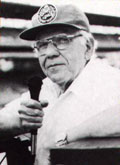
Tom Carnegie... Calling the Race Since WWII.
For the 1st century of automobile racing, folks have been coming to see the big race
in Indianapolis. Since the beginning, these same people have been coming back, and
bringing their kids. The race tickets get handed down through generations, traditions
start and dreams begin.
Now, in the year 2001, we begin a new century. By 2101, our great grandkids will be
attending.
I wonder what will be happening at the end of this century...
Perhaps one day the track will be lighted for a night race.
Maybe the road course will be extended outside of the oval.
Perhaps a giant retractable roof (or force field) that would allow the race to
continue in a rain storm.
Could the cars be replaced with anti-gravity scooters?
Maybe some day there will be a magnetic force field that prevents debris from going
into the stands.
Or a force field around the walls and cars so that they bounce harmlessly off each
other if they collide.
WAIT - if they invent that, then we can all go racing!!
More stands could be built along the back straight.
Oh well, those are Dan's Guesses for the year 2101.
If you have any that you would like me to put on here, just email me at
dan@indyspeedway.com
Dave, a transplanted Hoosier, now living in California, predicts:
Grandstands A, B, C, H, and The Paddock, along with possibly Grandstands E & J,
will be expanded, out over Georgetown road.
Georgetown Road, from Turn 1 to turn four, will consist of a tunnel running under the
Grandstands!
I hope you make it to the Indy 500 soon and start your own traditions!
(January 2001)
in Indianapolis. Since the beginning, these same people have been coming back, and
bringing their kids. The race tickets get handed down through generations, traditions
start and dreams begin.
Now, in the year 2001, we begin a new century. By 2101, our great grandkids will be
attending.
I wonder what will be happening at the end of this century...
Perhaps one day the track will be lighted for a night race.
Maybe the road course will be extended outside of the oval.
Perhaps a giant retractable roof (or force field) that would allow the race to
continue in a rain storm.
Could the cars be replaced with anti-gravity scooters?
Maybe some day there will be a magnetic force field that prevents debris from going
into the stands.
Or a force field around the walls and cars so that they bounce harmlessly off each
other if they collide.
WAIT - if they invent that, then we can all go racing!!
More stands could be built along the back straight.
Oh well, those are Dan's Guesses for the year 2101.
If you have any that you would like me to put on here, just email me at
dan@indyspeedway.com
Dave, a transplanted Hoosier, now living in California, predicts:
Grandstands A, B, C, H, and The Paddock, along with possibly Grandstands E & J,
will be expanded, out over Georgetown road.
Georgetown Road, from Turn 1 to turn four, will consist of a tunnel running under the
Grandstands!
I hope you make it to the Indy 500 soon and start your own traditions!
(January 2001)

Written in 2001