

Indy 500 parade queens, fluttering balloons,
fried-chicken feasts, and shrieking engines are so
indelibly embedded in the American psyche that it's
difficult to visualize the Indianapolis Motor Speedway
as anything but today's steel, concrete, and asphalt
temple of speed. But, like other inventions that evolved
into institutions, this one began as a zany idea.
In 1905, while assisting friends racing in France,
Indiana sportsman and entrepreneur Carl Fisher
observed that Europeans held the upper hand in
automobile design and craftsmanship. What America
needed to catch up, Fisher reckoned, was a better
means of testing cars before delivering them to
customers.
American racing was just getting started on horse
tracks and, occasionally, on public roads. But such
venues were ill-suited to either racing or car testing,
Fisher reasoned in a November 1906 letter to Motor
Age Magazine: "The average horse track is narrow,
has fences that are dangerous, and is always dusty or
muddy.
[W]ith high speed cars, where wide skids are
necessary, . . . the fastest car, from a slow start or
other temporary delay, gets [stuck] in the rear without
chances of ever gaining the front on account of
continuous seas of dust and skidding cars." Fisher
also argued that spectators didn't receive their
money's worth from an infrequent glance of a
hell-bent competitor racing past during a fifty-mile
open-road race.
fried-chicken feasts, and shrieking engines are so
indelibly embedded in the American psyche that it's
difficult to visualize the Indianapolis Motor Speedway
as anything but today's steel, concrete, and asphalt
temple of speed. But, like other inventions that evolved
into institutions, this one began as a zany idea.
In 1905, while assisting friends racing in France,
Indiana sportsman and entrepreneur Carl Fisher
observed that Europeans held the upper hand in
automobile design and craftsmanship. What America
needed to catch up, Fisher reckoned, was a better
means of testing cars before delivering them to
customers.
American racing was just getting started on horse
tracks and, occasionally, on public roads. But such
venues were ill-suited to either racing or car testing,
Fisher reasoned in a November 1906 letter to Motor
Age Magazine: "The average horse track is narrow,
has fences that are dangerous, and is always dusty or
muddy.
[W]ith high speed cars, where wide skids are
necessary, . . . the fastest car, from a slow start or
other temporary delay, gets [stuck] in the rear without
chances of ever gaining the front on account of
continuous seas of dust and skidding cars." Fisher
also argued that spectators didn't receive their
money's worth from an infrequent glance of a
hell-bent competitor racing past during a fifty-mile
open-road race.
Fisher proposed building a circular track three to five
miles long with smooth, 100- to 150-foot-wide racing
surfaces. Such a facility would provide manufacturers
an opportunity to test cars at sustained speeds and
give drivers a place to learn how to maintain control at
the limit. Fisher predicted that speeds would rise
beyond the 69 mph achieved on a one-mile horse
track to more than 100 mph on a three-mile circle and
at least 120 mph on a five-mile circuit. As Speedway
historian Donald Davidson points out, 120 mph was
practically the land speed record of the day.
Fisher knew he was literally on the right track after
visiting the Brooklands circuit that opened near
London in 1907. Seeing that steeply banked,
2.75-mile, pear-shaped course cemented his
determination to develop his dream. With dozens of
carmakers and suppliers in Indiana, a dual-purpose
track would be ideal for testing, and it would also be
the perfect venue for demonstrating a car's strengths
to the buying public through racing.
Fisher rejected two potential sites before his real-
estate agent found four adjoining tracts of level
farmland totaling 328 acres five miles northwest of
downtown Indianapolis. In December 1908, Fisher
convinced three partners to join in purchasing the
property for $72,000. The Indianapolis Motor
Speedway Company's incorporation papers listed
capitalization of $250,000, with Fisher and James
Allison in for $75,000 apiece and Frank Wheeler and
Arthur Newby onboard for $50,000 each.
miles long with smooth, 100- to 150-foot-wide racing
surfaces. Such a facility would provide manufacturers
an opportunity to test cars at sustained speeds and
give drivers a place to learn how to maintain control at
the limit. Fisher predicted that speeds would rise
beyond the 69 mph achieved on a one-mile horse
track to more than 100 mph on a three-mile circle and
at least 120 mph on a five-mile circuit. As Speedway
historian Donald Davidson points out, 120 mph was
practically the land speed record of the day.
Fisher knew he was literally on the right track after
visiting the Brooklands circuit that opened near
London in 1907. Seeing that steeply banked,
2.75-mile, pear-shaped course cemented his
determination to develop his dream. With dozens of
carmakers and suppliers in Indiana, a dual-purpose
track would be ideal for testing, and it would also be
the perfect venue for demonstrating a car's strengths
to the buying public through racing.
Fisher rejected two potential sites before his real-
estate agent found four adjoining tracts of level
farmland totaling 328 acres five miles northwest of
downtown Indianapolis. In December 1908, Fisher
convinced three partners to join in purchasing the
property for $72,000. The Indianapolis Motor
Speedway Company's incorporation papers listed
capitalization of $250,000, with Fisher and James
Allison in for $75,000 apiece and Frank Wheeler and
Arthur Newby onboard for $50,000 each.
Speedway workers oiled and rolled the track surface
until the gates opened to the public. Fifteen to twenty
thousand spectators poured in, each paying $1 for a
grandstand seat or 50 cents to sit in the first- and
second-turn bleachers.
Impatient drivers broke formation during the first three
rolling starts, forcing flagman Fred Wagner to halt the
field and begin all races from a standing start. Five-
and ten-mile event victors were Louis Schwitzer in a
Stoddard-Dayton, Louis Chevrolet in a Buick, Wilfred
Bourque in a Knox, and Ray Harroun in a Marmon.
Halfway through the first day's 250-mile main event,
race leader Chevrolet was temporarily blinded when
a stone smashed his goggles. Then Bourque suffered
a (suspected) rear-axle failure. His Knox flipped
end-for-end on the front straight before crashing into
a fence post. Bourque and riding mechanic Harry
Holcomb both died at the scene. Burman's Buick led
the remaining field to the finish.
In spite of the four safe finishes and two world speed
records achieved on Indy's first day of car racing,
AAA sanctioning officials debated canceling the
remainder of the schedule. Only after Fisher
promised that workers would repair the ravaged
track overnight were officials convinced that the show
should go on.
More than 20,000 spectators enjoyed the second
day's eight events, which were completed without
incident. Drivers behaved, records were broken,
and the track surface held up reasonably well.
until the gates opened to the public. Fifteen to twenty
thousand spectators poured in, each paying $1 for a
grandstand seat or 50 cents to sit in the first- and
second-turn bleachers.
Impatient drivers broke formation during the first three
rolling starts, forcing flagman Fred Wagner to halt the
field and begin all races from a standing start. Five-
and ten-mile event victors were Louis Schwitzer in a
Stoddard-Dayton, Louis Chevrolet in a Buick, Wilfred
Bourque in a Knox, and Ray Harroun in a Marmon.
Halfway through the first day's 250-mile main event,
race leader Chevrolet was temporarily blinded when
a stone smashed his goggles. Then Bourque suffered
a (suspected) rear-axle failure. His Knox flipped
end-for-end on the front straight before crashing into
a fence post. Bourque and riding mechanic Harry
Holcomb both died at the scene. Burman's Buick led
the remaining field to the finish.
In spite of the four safe finishes and two world speed
records achieved on Indy's first day of car racing,
AAA sanctioning officials debated canceling the
remainder of the schedule. Only after Fisher
promised that workers would repair the ravaged
track overnight were officials convinced that the show
should go on.
More than 20,000 spectators enjoyed the second
day's eight events, which were completed without
incident. Drivers behaved, records were broken,
and the track surface held up reasonably well.


Construction began in March 1909, with ambitious
plans to start racing by the Fourth of July. Then reality
set in. Fisher's vision of a three-mile oval surrounding
a two-mile road course became two 2.5-mile circuits
in order to leave room for grandstands. The final
Speedway consisted of four quarter-mile-long turns
linked by two five-eighths-mile straights and two
eighth-mile short chutes with the corners banked at
9.2 degrees. (Although the road course was dropped
from the century-ago plans, construction of an inner
circuit commenced in 1998 in preparation for Indy's
first Formula 1 race.)
The Dry Run creek running across a corner of the
property also posed problems. Construction
superintendent P. T. Andrews feared that the sixty
days allotted for grading might not be enough, so the
summer 1909 schedule was revised to hold a balloon
event in June and inaugural races in August.
Five hundred laborers, 300 mules, and a fleet of
steam-powered machinery reshaped the landscape.
The track surface consisted of graded and packed
soil covered by two inches of gravel, two inches of
limestone covered with taroid (a solution of tar and
oil), one to two inches of crushed stone chips that
were also drenched with taroid, and a final topping
of crushed stone. Steamrollers compressed each
layer.
plans to start racing by the Fourth of July. Then reality
set in. Fisher's vision of a three-mile oval surrounding
a two-mile road course became two 2.5-mile circuits
in order to leave room for grandstands. The final
Speedway consisted of four quarter-mile-long turns
linked by two five-eighths-mile straights and two
eighth-mile short chutes with the corners banked at
9.2 degrees. (Although the road course was dropped
from the century-ago plans, construction of an inner
circuit commenced in 1998 in preparation for Indy's
first Formula 1 race.)
The Dry Run creek running across a corner of the
property also posed problems. Construction
superintendent P. T. Andrews feared that the sixty
days allotted for grading might not be enough, so the
summer 1909 schedule was revised to hold a balloon
event in June and inaugural races in August.
Five hundred laborers, 300 mules, and a fleet of
steam-powered machinery reshaped the landscape.
The track surface consisted of graded and packed
soil covered by two inches of gravel, two inches of
limestone covered with taroid (a solution of tar and
oil), one to two inches of crushed stone chips that
were also drenched with taroid, and a final topping
of crushed stone. Steamrollers compressed each
layer.
Another army of workers constructed dozens of
buildings, several bridges, grandstands with 12,000
seats, and an eight-foot perimeter fence. A
white-with-green-trim paint scheme was used
throughout the property.
On the evening of June 5, 1909, nine gas-filled
balloons lifted off at Indy, "racing" for adulation and
silver trophies. University City, the winner of the
Speedway's first competitive event, landed 382
miles away in Alabama after spending more than a
day aloft.
buildings, several bridges, grandstands with 12,000
seats, and an eight-foot perimeter fence. A
white-with-green-trim paint scheme was used
throughout the property.
On the evening of June 5, 1909, nine gas-filled
balloons lifted off at Indy, "racing" for adulation and
silver trophies. University City, the winner of the
Speedway's first competitive event, landed 382
miles away in Alabama after spending more than a
day aloft.
Thirty-five thousand spectators showed up for Indy's
third day of speed trials and races in spite of hot,
humid weather. Oldfield wowed the fans by boosting
the world kilometer record to 85 mph in his Benz. The
cigar-chomping celebrity also won the day's fourth
event with ease.
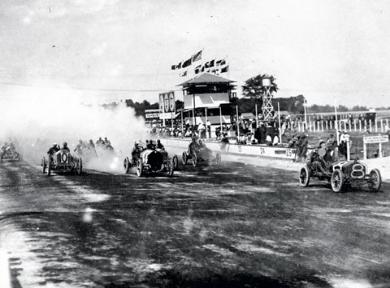
Nineteen racers took the flag in the grand finale,
a 300-mile run for the $10,000 Wheeler-Schebler
trophy. During the first 100 miles of dusty
competition, six cars dropped out. At 175 miles, the
right front tire blew on Charlie Merz's car. His
out-of-control National mowed down five south-end
fence posts, toppled spectators like bowling pins,
and achieved a reported 50-foot altitude. The lucky
Merz sustained only minor injuries, but two spectators
and his mechanic, Claude Kellum, perished.
Ten laps later, a Marmon driven by Bruce Keen spun
into a bridge support after hitting a pothole. Flagman
Wagner promptly halted the race with 94 of the
planned 120 laps completed. Since the event ended
early, the remaining cars received engraved
certificates instead of trophies.
The following day, newspapers railed against the
carnage. A Detroit News editorial deemed racing
"more brutal than bull fighting, gladiatorial combats,
or prize fighting." The AAA moved to boycott future
Indianapolis events unless Speedway management
addressed safety shortcomings.
Fisher and his partners agreed that motorsports
wouldn't thrive without major track improvements.
Construction engineer Andrews suggested paving
the entire racing surface with either bricks or
concrete. Bricks were twice as expensive, but they'd
last longer and provide superior traction, in his
opinion.
third day of speed trials and races in spite of hot,
humid weather. Oldfield wowed the fans by boosting
the world kilometer record to 85 mph in his Benz. The
cigar-chomping celebrity also won the day's fourth
event with ease.
Nineteen racers took the flag in the grand finale,
a 300-mile run for the $10,000 Wheeler-Schebler
trophy. During the first 100 miles of dusty
competition, six cars dropped out. At 175 miles, the
right front tire blew on Charlie Merz's car. His
out-of-control National mowed down five south-end
fence posts, toppled spectators like bowling pins,
and achieved a reported 50-foot altitude. The lucky
Merz sustained only minor injuries, but two spectators
and his mechanic, Claude Kellum, perished.
Ten laps later, a Marmon driven by Bruce Keen spun
into a bridge support after hitting a pothole. Flagman
Wagner promptly halted the race with 94 of the
planned 120 laps completed. Since the event ended
early, the remaining cars received engraved
certificates instead of trophies.
The following day, newspapers railed against the
carnage. A Detroit News editorial deemed racing
"more brutal than bull fighting, gladiatorial combats,
or prize fighting." The AAA moved to boycott future
Indianapolis events unless Speedway management
addressed safety shortcomings.
Fisher and his partners agreed that motorsports
wouldn't thrive without major track improvements.
Construction engineer Andrews suggested paving
the entire racing surface with either bricks or
concrete. Bricks were twice as expensive, but they'd
last longer and provide superior traction, in his
opinion.
Since the first mile of paved public road was also
under construction in 1909, Speedway owners had
no experience on which to base their decision.
Traction tests were conducted, proving the brick
approach to be clearly superior. Funds were
authorized to begin the repaving project less than a
month after the pioneering racers left the track.
Five Indiana manufacturers supplied 3.2 million ten-
pound bricks, which were each hand laid over a
two-inch sand cushion. After the surface was leveled
with a steamroller, gaps were filled with mortar. To
safeguard spectators, a 33-inch-high concrete wall
was also constructed in front of the main grandstand
and around all four turns.
Although it was too late in the season to resume
racing, eleven drivers and a few motorcycles returned
in December for speed trials. Hardy spectators
braved winds and 10-degree temperatures to witness
Walter Christie top 100 mph in his purpose-built,
front-wheel-drive racer and his nephew, Lewis Strang,
achieve 112 mph in a Fiat. Race starter Wagner
issued two proclamations: that the Speedway was
now "a wonderful track and will allow for the speed
that any car today has stored away in it" and that
"100 mph is as fast as the American public will care
for."
Give the man half credit. During the next seven years,
no drivers and only one riding mechanic died racing at
the Brickyard. However, Wagner underestimated the
typical fan's zest for speed. No tears were shed in
1919 when René Thomas was the first pole-winner to
qualify over 100 mph or when Tom Sneva cracked the
200-mph barrier in 1978.
under construction in 1909, Speedway owners had
no experience on which to base their decision.
Traction tests were conducted, proving the brick
approach to be clearly superior. Funds were
authorized to begin the repaving project less than a
month after the pioneering racers left the track.
Five Indiana manufacturers supplied 3.2 million ten-
pound bricks, which were each hand laid over a
two-inch sand cushion. After the surface was leveled
with a steamroller, gaps were filled with mortar. To
safeguard spectators, a 33-inch-high concrete wall
was also constructed in front of the main grandstand
and around all four turns.
Although it was too late in the season to resume
racing, eleven drivers and a few motorcycles returned
in December for speed trials. Hardy spectators
braved winds and 10-degree temperatures to witness
Walter Christie top 100 mph in his purpose-built,
front-wheel-drive racer and his nephew, Lewis Strang,
achieve 112 mph in a Fiat. Race starter Wagner
issued two proclamations: that the Speedway was
now "a wonderful track and will allow for the speed
that any car today has stored away in it" and that
"100 mph is as fast as the American public will care
for."
Give the man half credit. During the next seven years,
no drivers and only one riding mechanic died racing at
the Brickyard. However, Wagner underestimated the
typical fan's zest for speed. No tears were shed in
1919 when René Thomas was the first pole-winner to
qualify over 100 mph or when Tom Sneva cracked the
200-mph barrier in 1978.
Troubled by poor eyesight and a short attention span,
Carl Fisher dropped out of school at age twelve.
After racing, repairing, and selling bicycles, he
became one of America's first car dealers, in
affiliation with racer Barney Oldfield. In 1904, Fisher
and fellow bike racer James Allison each invested a
reported $2500 to manufacture Prest-O-Lite
automobile headlamps; Union Carbide bought
control years later for $9 million. At a dinner party for
auto manufacturers in 1912, the intrepid Fisher
proposed building America's first transcontinental
road, which became the Lincoln Highway. The Dixie
Highway, a road system connecting Michigan's
Upper Peninsula with Miami, was his next bold
stroke. Fisher's hot streak continued with real-estate
developments in Miami Beach and Montauk Point,
New York. A devastating hurricane and the 1929
stock-market crash wiped out Fisher's fortune, but
his legacy, as described by Will Rogers, was having
achieved "more unique things . . . than any man I
ever met."
Allison, Fisher's longtime ally, brought stability to their
ventures. Coincidentally, he also left school at age
twelve. Allison, Fisher, and a third Speedway founder,
Arthur Newby, met at the Zig-Zag Cycling Club. It was
allegedly Allison's idea to shift the Speedway's focus
from several short events to one spectacular
endurance race per year, beginning in 1911. His
precision machine shop located near the track
manufactured tanks, trucks, and Liberty V-12 aircraft
engines during World War I. Following Allison's death
in 1928, General Motors acquired Allison
Engineering, which built aircraft V-12s for World War
II and jet engines thereafter. More recently, Allison
engineers also conceived GM's two-mode hybrid
system.
Carl Fisher dropped out of school at age twelve.
After racing, repairing, and selling bicycles, he
became one of America's first car dealers, in
affiliation with racer Barney Oldfield. In 1904, Fisher
and fellow bike racer James Allison each invested a
reported $2500 to manufacture Prest-O-Lite
automobile headlamps; Union Carbide bought
control years later for $9 million. At a dinner party for
auto manufacturers in 1912, the intrepid Fisher
proposed building America's first transcontinental
road, which became the Lincoln Highway. The Dixie
Highway, a road system connecting Michigan's
Upper Peninsula with Miami, was his next bold
stroke. Fisher's hot streak continued with real-estate
developments in Miami Beach and Montauk Point,
New York. A devastating hurricane and the 1929
stock-market crash wiped out Fisher's fortune, but
his legacy, as described by Will Rogers, was having
achieved "more unique things . . . than any man I
ever met."
Allison, Fisher's longtime ally, brought stability to their
ventures. Coincidentally, he also left school at age
twelve. Allison, Fisher, and a third Speedway founder,
Arthur Newby, met at the Zig-Zag Cycling Club. It was
allegedly Allison's idea to shift the Speedway's focus
from several short events to one spectacular
endurance race per year, beginning in 1911. His
precision machine shop located near the track
manufactured tanks, trucks, and Liberty V-12 aircraft
engines during World War I. Following Allison's death
in 1928, General Motors acquired Allison
Engineering, which built aircraft V-12s for World War
II and jet engines thereafter. More recently, Allison
engineers also conceived GM's two-mode hybrid
system.
The Newby Oval, a quarter-mile, steeply banked
velodrome, was the magnet that drew together three
of Indy's founders. Under Newby's leadership, the
National Motor Vehicle Company in Indianapolis
progressed from building electric runabouts to
gasoline-powered cars.
The fourth founder was Frank Wheeler, who claimed
to have lost two fortunes before arriving in
Indianapolis in 1904 and joining with George
Schebler to manufacture carburetors. Their firm
sponsored Indy's first trophy, a towering Tiffany cup.
Wheeler tried to spread Indy magic to a grandiose
Minnesota track; after that venture failed, he sold his
Speedway interests to Allison in 1917.
Louis Schwitzer, who had no hand in the
Speedway's creation, deserves honorable mention
for winning Indy's first race in a Stoddard-Dayton.
Competing against four other stock-chassis cars in
a five-mile sprint, Schwitzer averaged 57 mph, led
both laps, and won by a 150-foot margin. Schwitzer
had earlier emigrated from Austria with two
engineering degrees and $18 in his pocket.
Following stints at Pierce-Arrow and a Canadian car
company, he helped design the engine that powered
Ray Harroun's Marmon to victory at the first Indy 500
race in 1911. Schwitzer headed the Speedway's
technical committee from 1912 through 1940. Also,
an Indianapolis company he established
manufactured superchargers and turbochargers. In
1952, a Kurtis Kraft roadster powered by a
Schwitzer-turbocharged Cummins diesel qualified
on the pole at Indy.
velodrome, was the magnet that drew together three
of Indy's founders. Under Newby's leadership, the
National Motor Vehicle Company in Indianapolis
progressed from building electric runabouts to
gasoline-powered cars.
The fourth founder was Frank Wheeler, who claimed
to have lost two fortunes before arriving in
Indianapolis in 1904 and joining with George
Schebler to manufacture carburetors. Their firm
sponsored Indy's first trophy, a towering Tiffany cup.
Wheeler tried to spread Indy magic to a grandiose
Minnesota track; after that venture failed, he sold his
Speedway interests to Allison in 1917.
Louis Schwitzer, who had no hand in the
Speedway's creation, deserves honorable mention
for winning Indy's first race in a Stoddard-Dayton.
Competing against four other stock-chassis cars in
a five-mile sprint, Schwitzer averaged 57 mph, led
both laps, and won by a 150-foot margin. Schwitzer
had earlier emigrated from Austria with two
engineering degrees and $18 in his pocket.
Following stints at Pierce-Arrow and a Canadian car
company, he helped design the engine that powered
Ray Harroun's Marmon to victory at the first Indy 500
race in 1911. Schwitzer headed the Speedway's
technical committee from 1912 through 1940. Also,
an Indianapolis company he established
manufactured superchargers and turbochargers. In
1952, a Kurtis Kraft roadster powered by a
Schwitzer-turbocharged Cummins diesel qualified
on the pole at Indy.
| 300-Mile Wheeler-Schebler Trophy Race |
| 1st Ever Balloon Race |
| Founders |
| Louis Chevrolet |
| Louis Switzer and Crew |

| INDY SPEEDWAY HISTORY |
Motorcycle races, daringly scheduled to begin on
Friday, August 13, were hampered by construction
delays, rain, riders who wouldn't race, tire blowouts,
and complaints about the track surface. Only 3500
spectators showed up, and contentious officials
canceled more than half of the planned events. Erwin
G. (later known as Cannonball) Baker won the final
ten-mile race, averaging 52 mph on his Indian.
Friday, August 13, were hampered by construction
delays, rain, riders who wouldn't race, tire blowouts,
and complaints about the track surface. Only 3500
spectators showed up, and contentious officials
canceled more than half of the planned events. Erwin
G. (later known as Cannonball) Baker won the final
ten-mile race, averaging 52 mph on his Indian.
Fifteen carmakers' teams arrived for practice two
days later. Bob Burman, Louis Chevrolet, and Barney
Oldfield were the professional stars. Engineers and
testers employed by participating manufacturers
filled out the drivers' roster. Oldfield quickly set the
bogey with a 76-mph lap in his Blitzen Benz.
According to D. Bruce Scott, author of Indy: Racing
Before the 500, there were immediate problems with
the track surface: "[Drivers] quickly became covered
in dirt, oil, and tar from head to toe. Then ruts and
chuckholes began to form . . . , particularly in the
turns. . . . Driving on the track was like flying through
a meteor shower [of gravel]."
days later. Bob Burman, Louis Chevrolet, and Barney
Oldfield were the professional stars. Engineers and
testers employed by participating manufacturers
filled out the drivers' roster. Oldfield quickly set the
bogey with a 76-mph lap in his Blitzen Benz.
According to D. Bruce Scott, author of Indy: Racing
Before the 500, there were immediate problems with
the track surface: "[Drivers] quickly became covered
in dirt, oil, and tar from head to toe. Then ruts and
chuckholes began to form . . . , particularly in the
turns. . . . Driving on the track was like flying through
a meteor shower [of gravel]."

| August 14, 1909 Motorcycle Race |

| Page 1 |
| Page 2 |
| Page 3 |
| Page 4 |
| Page 6 THE FOUNDERS |
In 1910 "Aviation Week" took place June 13-18 in
Indianapolis and featured "one of the most unique
chapters of Indianapolis Motor Speedway history".
A six-day aviation show that featured appearances by
the Wright brothers, something like 35 events, and
numerous record-breaking flights. Not bad considering
their first flight had only happened seven years
previously! Other pilots were trained by the Wright
Brothers.
Indianapolis and featured "one of the most unique
chapters of Indianapolis Motor Speedway history".
A six-day aviation show that featured appearances by
the Wright brothers, something like 35 events, and
numerous record-breaking flights. Not bad considering
their first flight had only happened seven years
previously! Other pilots were trained by the Wright
Brothers.


| Page 5 1910 Air Show |
8-minute Video of First Indy 500 - May 30, 1911
| Related Pages: |

News
Teams/Drivers
Schedules/Results
Statistics
Series
Photos
Links
History
Indy 500 Memorial
F1 vs. Indycar
General Info
Things To Do
What To Take
Food & Drink
Where To Sit
Seating Chart
Tickets
Maps
Parking
Transportation
Camping
The Party
Cool Tales
Indy 500 FAQ
City Guide
Teams/Drivers
Schedules/Results
Statistics
Series
Photos
Links
History
Indy 500 Memorial
F1 vs. Indycar
General Info
Things To Do
What To Take
Food & Drink
Where To Sit
Seating Chart
Tickets
Maps
Parking
Transportation
Camping
The Party
Cool Tales
Indy 500 FAQ
City Guide